Every time you open your phone, short video apps recommend content you love, and voice assistants understand your commands—these rely on artificial intelligence (AI). But have you ever wondered about the differences between the terms “artificial intelligence,” “machine learning,” and “deep learning”? Today, we’ll clarify their relationships in the simplest way.
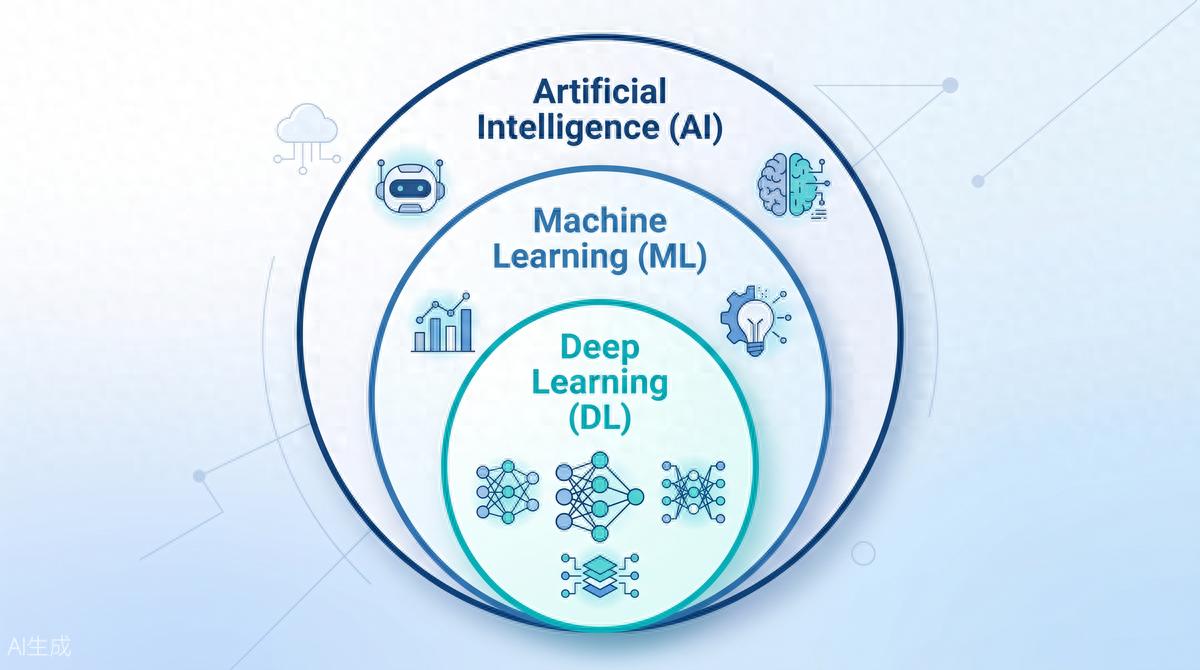
The Relationship Between the Three Terms
To reveal the answer: these three terms have an “inclusion relationship,” similar to Russian nesting dolls—artificial intelligence is the largest doll, machine learning is nestled in the middle, and deep learning is the smallest but most intricate one inside.
In other words, artificial intelligence is the broadest concept, machine learning is a method to achieve AI, and deep learning is a “powerful branch” of machine learning. You can visualize this as three concentric circles: the outer layer is artificial intelligence (AI), the middle layer is machine learning (ML), and the innermost layer is deep learning (DL). Each inner circle is part of the outer circle. This is akin to “university” encompassing “computer science major,” with the computer science major containing the “artificial intelligence research direction”—layered nesting.

Artificial Intelligence: A “Big Basket”
Artificial intelligence (AI) is the broadest and oldest concept among the three. In the 1950s, scientists proposed the idea: can machines think like humans?
Since then, AI has become a “big basket” where all technologies that allow machines to simulate human intelligence can be placed. Early AI followed a “rule-driven” approach—scientists wrote knowledge and rules into programs line by line, such as “if you see ‘hello,’ reply with ‘hello there.’” The 1997 chess champion-defeating “Deep Blue” followed this path.
However, the real world has too many rules to write down comprehensively. Relying on manually written rules is like using a small booklet to record all the world’s knowledge, which is destined to fail. Thus, scientists began to ponder: can machines learn on their own? This idea led to the birth of machine learning.
Machine Learning: Letting Machines “Learn on Their Own”
The core idea of machine learning (ML) is simple: provide machines with a large amount of data and let them find patterns themselves, rather than having humans write the rules.
For example, traditional AI is like a student memorizing standard answers, where the teacher must clearly explain the solution to every problem; whereas machine learning is like a student who learns by practicing a large number of exercises and summarizes problem-solving patterns on their own. The teacher doesn’t need to tell them “how to do it”; they just provide “enough practice problems and correct answers,” and they can figure it out.
Machine learning is ubiquitous in daily life: spam filters in email learn to identify junk mail after processing thousands of emails; shopping apps predict products you might like by analyzing your browsing history. Banks assess whether transactions are fraudulent, and navigation apps predict traffic conditions—all driven by machine learning.
However, early machine learning still required human experts to help machines “extract features”—indicating what information to focus on. Was there a way to skip this step and let machines decide what to pay attention to? Thus, deep learning emerged.
Deep Learning: Allowing Machines to “Learn More Deeply”
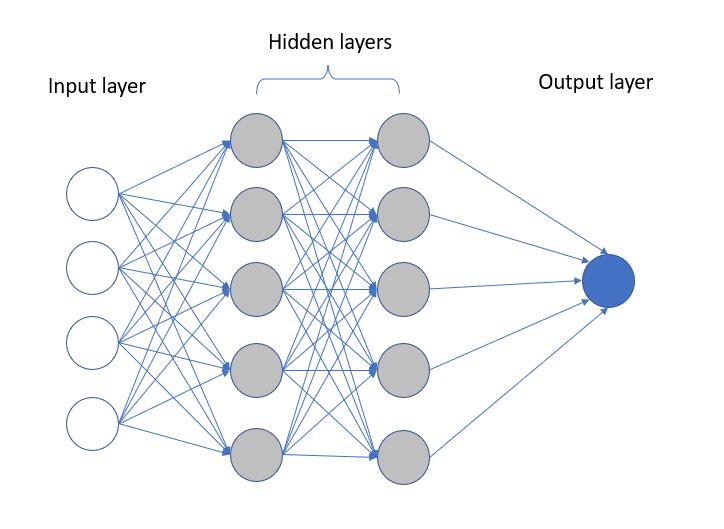
Deep learning (DL) is a branch of machine learning, with its core weapon being “neural networks”—a computational model that simulates the way human brain neurons work.
“Deep” refers to the many layers of the neural network. You can think of it as a multi-layer sieve: data is poured in from the top, and each layer extracts different levels of features, progressing layer by layer. For example, in recognizing a cat in a photo, the first layer identifies edges and lines, the second layer recognizes the contours of eyes and ears, and the third layer combines these to conclude, “this is a cat.” The entire process is fully automated, without needing humans to tell it, “cats have pointy ears.”
Deep learning exploded around 2010, thanks to three conditions: the accumulation of massive data, a significant increase in computational power (especially GPUs), and breakthroughs in algorithms. It has achieved remarkable results in image recognition, speech processing, and more. The facial unlock feature on your phone, speech-to-text, and the popular ChatGPT and other large language models are essentially products of deep learning.
Deep learning can be considered the “strongest child” in the machine learning family and the core driving force behind recent breakthroughs in AI.
A Visual Summary of Their Relationships
To remember the relationship among these three concepts, consider this analogy:
- Artificial Intelligence = the entire “school”
- Machine Learning = the “computer science major” within the school
- Deep Learning = the “AI research direction” within the major
In terms of scope: Artificial Intelligence ⊃ Machine Learning ⊃ Deep Learning ("⊃" indicates inclusion). All deep learning is machine learning, and all machine learning is artificial intelligence, but the reverse is not true.
Next time you see a statement like “a company has powerful AI technology,” know that this is a broad claim; if it says “uses deep learning,” it means they are employing a more advanced technology involving multi-layer neural networks.
Summary of Key Points Learned Today:
- The three terms have an inclusion relationship: artificial intelligence is the broadest concept, machine learning is its subset, and deep learning is a subset of machine learning, layered nesting.
- The core difference lies in the learning methods: traditional AI relies on manually written rules, machine learning automatically finds patterns from data, and deep learning uses multi-layer neural networks to automatically extract features, becoming increasingly “intelligent.”
- Deep learning is the backbone of today’s AI: impressive applications like image recognition, voice assistants, and ChatGPT are almost all driven by deep learning.
Understanding the relationships among these three concepts gives you a clearer picture of the AI technology landscape than most people. In the next article, we will discuss the hottest concept in the past two years: what exactly are large language models?
Comments
Discussion is powered by Giscus (GitHub Discussions). Add
repo,repoID,category, andcategoryIDunder[params.comments.giscus]inhugo.tomlusing the values from the Giscus setup tool.